ISC2 AI Security Pilot Exam · Free study guide
Domain 5 Study Notes: Secure AI Operations and Incident Response
How to use these notes
Domain 5 is about running AI systems day to day and handling things when they go wrong. The first half covers operations: readiness, monitoring, detection and vulnerability management. The second half follows an AI incident from triage through containment, investigation, recovery and the lessons afterward. No operations or incident response background is assumed; every term is defined where it first appears. I've followed the ISC2 outline section by section, and each section ends with how I expect it to show up on the exam.
The incident response lifecycle itself isn't new. NIST's incident response guidance, SP 800-61, was revised in 2025 to line up with the NIST Cybersecurity Framework 2.0, and the classic phases still apply: prepare, detect and analyze, contain, eradicate, recover, and learn. What changes with AI is the evidence and the actions. An AI incident may leave no malware and no exploited server behind, only a model that behaves differently, a poisoned document in a knowledge base or an agent that did exactly what an injected instruction told it to.
One idea runs through the domain: you can only investigate what you recorded. Prompts, tool calls, model versions and dataset snapshots have to be captured before an incident, or there will be nothing to reconstruct afterward.
Everything here is my own work, built from public frameworks and guidance. If a reference book frames something differently, trust the book.
5.1 AI SecOps foundations and operational readiness
SecOps (security operations) is the ongoing work of monitoring, detecting and responding to threats. Operational readiness means the people, processes and tools are in place before a system goes live, so the first incident isn't also the first time anyone thought about incidents.
Core security principles in AI operations
Least privilege and separation of duties (Domain 4) apply to the people and tools that operate AI, too. Operators get only the access their job needs. No single person can both change a production model and approve its release, so production changes need two people. Emergency break-glass accounts exist for when normal access fails, and every use of one is alerted and reviewed. Logs that contain prompts are sensitive, so access to them follows need to know.
AI operational roles and responsibilities
| Role | Responsible for |
|---|---|
| Model owner | The model's behavior, performance and risk; approves releases and accepts residual risk for it |
| Data owner | The datasets the model uses; approves how they're used (Domain 3) |
| Use-case or product owner | The business outcome the AI system delivers |
| MLOps or platform engineer | Running the pipelines, infrastructure and deployments |
| Data scientist | Building, evaluating and retraining models |
| SecOps analyst | Monitoring, detection and incident response |
| Legal, privacy and compliance | Regulatory obligations, including breach notification |
A RACI matrix assigns each activity a Responsible party (who does the work), an Accountable party (who owns the outcome), and those Consulted and Informed. Each activity gets exactly one Accountable party. When everyone is accountable, nobody is.
Release requirements
Release requirements are the conditions a model must meet before it goes live, and they also define what normal operation looks like afterward. The outline names two that are specific to AI:
- A human override baseline documents and tests the ability of people to override or stop the system, and records the expected override rate once it's running. Changes in that rate tell you something. A rising override rate suggests the model is getting worse. A rate that falls to almost zero may mean reviewers have stopped reading and started approving everything.
- A reject rate threshold sets the acceptable range for how often the system refuses or blocks requests, or how often people reject its outputs. A rate above the range can mean over-blocking or an attack in progress. A sudden drop can mean a guardrail stopped working.
Other common release requirements include evaluation and bias scores above set thresholds, clean security scans, latency targets, a tested rollback, monitoring in place and runbooks written.
Playbooks, runbooks and tabletop exercises
- A playbook is the plan for a type of incident: who's involved, which decisions get made and by whom, how to escalate and how to communicate.
- A runbook is the step-by-step technical procedure for one task, like rolling back a model to the last approved version, rotating an agent's credentials or removing entries from a vector store.
- A tabletop exercise is a discussion-based simulation where the team walks through a scenario together and finds the gaps in its plans before a real incident does.
Useful AI tabletop scenarios include poisoned data discovered in a production model, tampered weights found in the model registry, an agent sending data out because of an injected instruction, a deepfaked executive's voice requesting a wire transfer, and an outage at the model provider. The goal is to test decisions: who can pull a model out of service, when legal must be told, and what you'll say to customers.
Configuration management and drift
Configuration management (CM) sets an approved baseline configuration and controls every change to it. For AI, the configuration includes far more than server settings: the model version, system prompt, guardrail settings, model parameters, tool lists and their permissions, RAG sources and index version, rate limits and provider endpoints. Any of them can change the system's behavior.
Automated model updates are a hidden risk. Some providers point an endpoint name like "latest" at whichever version is newest, and some pipelines retrain and redeploy automatically. In production, pin specific versions and send every update through change control and testing.
Configuration drift is the gap that opens over time between the approved baseline and what's actually running, through quick fixes to a system prompt or a filter someone loosened to resolve a complaint. Keep configuration in version control as code, compare running configuration against the baseline automatically, and alert on differences.
5.2 Monitoring, logging and AI security telemetry
Telemetry is the data a system emits about what it's doing. Traditional security telemetry covers logins, network flows and process activity. AI systems need all of that plus a new layer that shows what the model was asked, what it read and what it did.
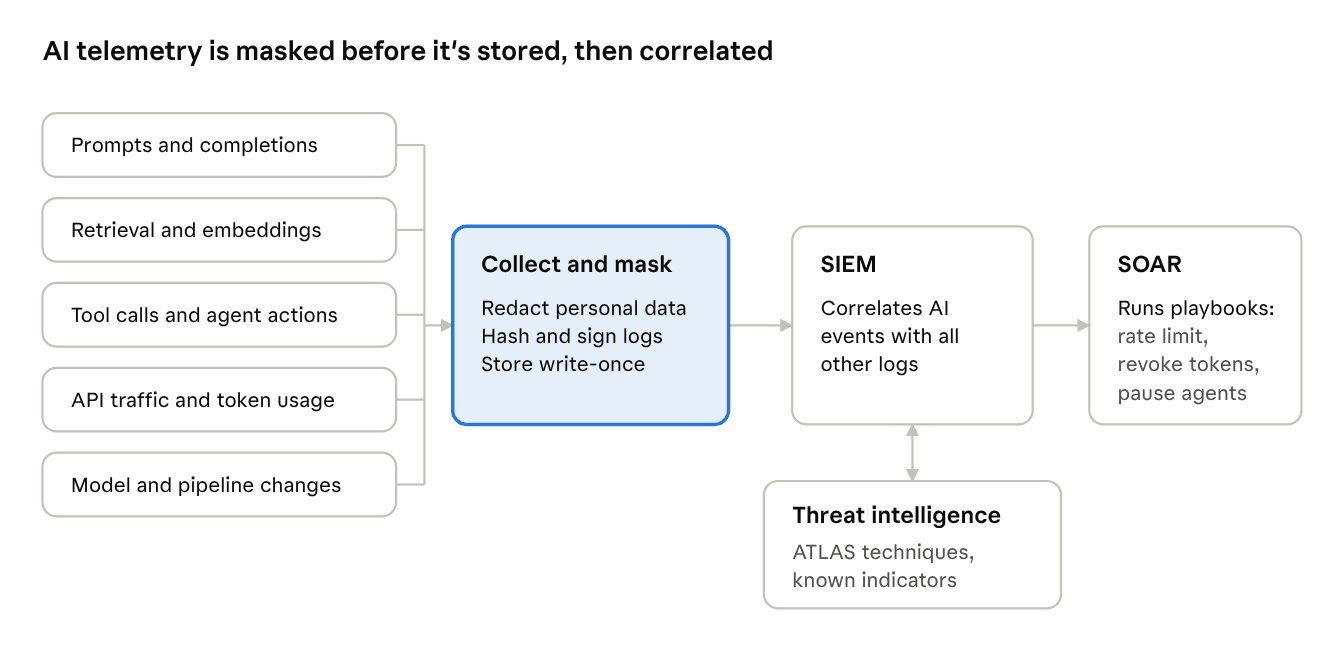
AI telemetry data
| Telemetry | What it shows | What to watch for |
|---|---|---|
| Prompts and completions | What people asked and what the model answered | Injection attempts, jailbreaks, sensitive data going in or coming out |
| Retrieval events and embeddings | Which documents were retrieved, and for whom | Documents outside the person's permissions, a suspicious document retrieved again and again |
| Tool calls | Which tools an agent called, with which parameters, and what came back | Unexpected tools, unusual parameters, sudden spikes in volume |
| API traffic | Requests, sources, tokens used, errors and latency | Extraction patterns, abuse, denial of wallet |
| Model and configuration changes | Version, system prompt and guardrail changes | Unauthorized changes and drift |
Every event also needs identity context: which person, which agent, acting on whose behalf, in which session. Standards are emerging here too; OpenTelemetry, the common open standard for system telemetry, has published conventions for recording generative AI activity consistently.
Correlating events across SIEM, SOAR and threat intelligence
A Security Information and Event Management (SIEM) system collects logs from many sources and correlates them to find patterns no single log shows. Picture three events that each look minor: a prompt containing an injection pattern, retrieval of a document from an unusual source, and an agent tool call sending email to an outside domain. Correlated, they're one incident.
Security Orchestration, Automation and Response (SOAR) runs automated playbooks when an alert fires: enrich it with context, throttle the user, revoke an agent's token, open a ticket and page the on-call analyst. Automation buys speed; high-impact decisions still go to a person.
Threat intelligence is information about adversaries and how they operate. For AI, useful feeds include MITRE ATLAS techniques, known jailbreak prompts, hashes of known malicious models, reports of malicious MCP servers and vendor security advisories. It feeds detection rules and adds context to alerts.
Log integrity and evidence documentation
Logs are only useful as evidence if they can be trusted. Send them off the host to central storage quickly, store them write-once, chain or sign them so tampering shows, synchronize clocks so timestamps line up across systems, restrict who can read them and log that access, and keep them as long as legal requirements say. When logs become evidence, document the chain of custody (Domain 3): who collected what, when, how, and the hash of each item.
Privacy-preserving telemetry masking
Here's the tension: investigators need prompts, and prompts are full of personal data. Telemetry masking resolves it by protecting the sensitive parts before storage:
- detect and redact or tokenize personal data before logs reach the SIEM;
- pseudonymize user identifiers;
- keep full, unmasked prompts in a separate restricted store with short retention, and send masked versions to the SIEM;
- for low-risk applications, sample traffic instead of storing all of it; and
- require a documented justification to view unmasked data, and log every time someone does.
Reversible tokenization is useful here. Masking that destroys what investigators need is its own failure, and reversible tokens let authorized investigators recover the original when an incident calls for it.
Real-time monitoring of behavior, drift and agent actions
- AI behavior: refusal, override and reject rates, policy violation rates, and for RAG, groundedness scores that measure whether answers are supported by the retrieved sources.
- Performance drift: accuracy on labeled samples, data drift statistics, latency and error rates.
- Agent actions: every tool call as it happens, with alerts on high-risk actions, actions outside the agent's normal pattern, loops and spend spikes, plus the ability to pause an agent instantly.
None of these alerts work without a baseline. Measure normal behavior first, then alert on departures from it.
5.3 Detecting runtime threats, misuse and compromise
Runtime means while the system is running in production, as opposed to during development or testing. Runtime detection catches attacks as they happen.
Runtime threat detection at each layer
| Layer | What an attack looks like | How to detect it |
|---|---|---|
| Inputs and prompts | Injection phrases, role-play jailbreaks, encoded payloads, someone rephrasing again and again after refusals | Injection classifiers, pattern rules, tracking refusal-then-retry sequences within a session |
| Retrieval chains | Documents that contain instructions, a newly added document suddenly retrieved constantly, content from unapproved sources | Scanning content as it's indexed, monitoring retrieval frequency, checking provenance |
| Outputs | Personal data, leaked system prompts, links to unknown domains, data hidden in URLs | Output DLP, canary tokens, an allow-list for link domains |
| Resource consumption | Token spikes, very long prompts, repeated maximum-length outputs, many parallel sessions on one key | Quotas plus thresholds based on normal usage |
Two techniques are worth knowing by name. A canary token is a unique string planted somewhere it should never leave, like a system prompt or a sensitive document. If it ever shows up in an output or anywhere else, you know something leaked. And watch for exfiltration through rendered links: an injected instruction gets the model to output an image link whose web address carries stolen data, and when the user's browser loads the image, the data goes to the attacker. Restricting which domains outputs may link to blocks it.
AI access and agency misuse
- Unauthorized identities show up as calls from agents nobody registered, API keys used from new locations, and tokens still in use after their owner left.
- Over-privileged agents show up as agents using permissions they rarely use, reaching systems they've never touched, or acting outside their declared task.
The detection method is the same for both: compare each identity's actions against its declared scope and its own history, and alert when an agent does something new.
Secret exposure and tool execution anomalies
Run secret scanning on prompts, outputs, logs and code. A credential appearing in a model's output is a serious finding, because it means a secret was in the model's context where it never belonged (Domain 4). Honeytokens, fake credentials that trigger an alert the moment anyone uses them, catch attackers who harvest secrets.
Tool execution anomalies include unusual sequences, like reading a sensitive file and then calling an outside web address; parameters outside normal ranges; tools called that weren't part of the agent's plan; spikes in failures and retries; commands containing shell control characters; and calls to destinations never seen before.
AI asset and lifecycle integrity
Attackers don't always attack the running system; sometimes they change what it's built from. Watch for:
- model files whose hashes don't match the registry, checked at load time and periodically;
- registry events like a new version registered by an unusual identity, or one missing a signature;
- knowledge base changes such as bulk additions, edits by unusual accounts or new sources;
- dataset snapshots whose hashes have changed; and
- pipeline changes, like edits to pipeline definitions, new build runners or disabled gates. A disabled gate is a red flag.
AI-driven security operations
AI is also a tool for defenders.
- User and Entity Behavior Analytics (UEBA) builds a baseline of normal behavior for each user and entity and flags departures from it. Agents and service accounts belong in it as entities, since unusual agent behavior is one of the best signs of compromise.
- Automated alert triage uses AI to summarize, enrich and rank alerts and to draft investigation notes, which cuts alert fatigue. The catch is that a triage model reads attacker-controlled data, like log entries and email content, so it can be prompt-injected too. Its conclusions can also be wrong. Keep a person in charge of closing high-severity alerts, and give SOC agents least privilege like any other agent.
- Threat hunting is a proactive, hypothesis-driven search for threats that no alert caught. AI helps write queries and spot patterns, and MITRE ATLAS is a good source of hypotheses to hunt for.
5.4 AI vulnerability and asset posture management
Model vulnerability and exposure registers
A vulnerability register lists known weaknesses in AI assets, each with the affected asset, severity, owner, status and due date. AI weaknesses include jailbreak techniques that worked in red teaming, published vulnerabilities in AI frameworks and libraries, insecure configurations and ways around guardrails. Findings come from red team exercises, vendor advisories, the CVE system, MITRE ATLAS case studies and public AI incident and vulnerability databases.
An exposure register records where each asset can be reached from and what it can reach: whether an endpoint faces the internet, which data and tools a model or agent can touch, and who its users are. Exposure decides how much a vulnerability matters.
One difference from traditional vulnerability management: many model weaknesses have no patch. There's no update that makes a model immune to jailbreaks. So the register tracks mitigations and documented risk acceptance as well as fixes.
Prioritizing by context and consequence
CVSS, the common vulnerability scoring system, rates severity in isolation. Real priority depends on context:
- Exposure: is it reachable from the internet, or only internally?
- Data: what's the most sensitive data it can reach?
- Agency: can it take actions, or only produce text?
- Human impact: could exploitation hurt people, their rights or their money?
- Exploitability: is it being exploited in the wild? CISA's Known Exploited Vulnerabilities catalog and EPSS, a model that estimates the probability of exploitation, both help answer that.
Take the same jailbreak weakness in two places. In an internal tool that summarizes public documents, it's a low priority. In an agent that can issue payments, it's urgent. CISA's SSVC (Stakeholder-Specific Vulnerability Categorization) formalizes this kind of decision as a tree built on exploitation status and impact.
Patch management for AI pipelines and open source components
AI stacks pile up dependencies quickly: Python packages, GPU drivers, machine learning frameworks, model serving software, vector databases, orchestration libraries, MCP servers and notebook environments, most of them open source. Good practice:
- keep an SBOM and AIBOM so you know what you're running (Domain 2);
- scan dependencies for vulnerabilities in the pipeline;
- pin versions and update deliberately, with patch deadlines set by severity;
- run the evaluation suite after updates, because a dependency change can shift model outputs in subtle ways;
- roll out in stages; and
- remove packages that are no longer maintained.
For the models themselves, "patching" means moving to a provider's fixed version, retraining, or adding guardrails around a weakness that can't be fixed directly.
Compensating controls for legacy models
A legacy model is an older model that can't easily be updated: the vendor no longer supports it, retraining isn't practical, or it was validated for a regulated use and any change would require costly revalidation. When it has to stay in service, compensating controls reduce the risk in other ways:
- isolate it on the network and remove its tool access;
- tighten input and output filtering;
- require human review of its outputs;
- add monitoring and rate limits; and
- impose strict usage restrictions on who may use it, for which tasks and with which kinds of data, with no new integrations allowed.
Pair those controls with a documented risk acceptance that has an expiry date and a retirement plan. Legacy should be a temporary state.
Continuous security reviews and posture metrics
AI Security Posture Management (AI-SPM) tools discover AI assets such as models, agents, endpoints and datasets, check their configurations against policy, find shadow AI and map attack paths. They make review continuous, on top of the scheduled and triggered reviews from Domain 2.
Posture metrics turn that into numbers leadership can track over time:
| Area | Example metrics |
|---|---|
| Coverage | Share of AI assets inventoried with an owner; share with a model card; share behind guardrails |
| Vulnerabilities | Mean time to fix by severity; open critical findings; findings past their deadline |
| Detection and response | Mean time to detect and to contain AI incidents |
| Testing | Share of releases red-teamed; jailbreak success rate in the latest red team exercise |
| Hygiene | Orphaned non-human identities; unpinned model versions in production; shadow AI tools found |
5.5 Responding to and containing AI incidents
The rest of this domain follows an incident from start to finish. Here's the whole lifecycle, with the AI-specific work at each phase:
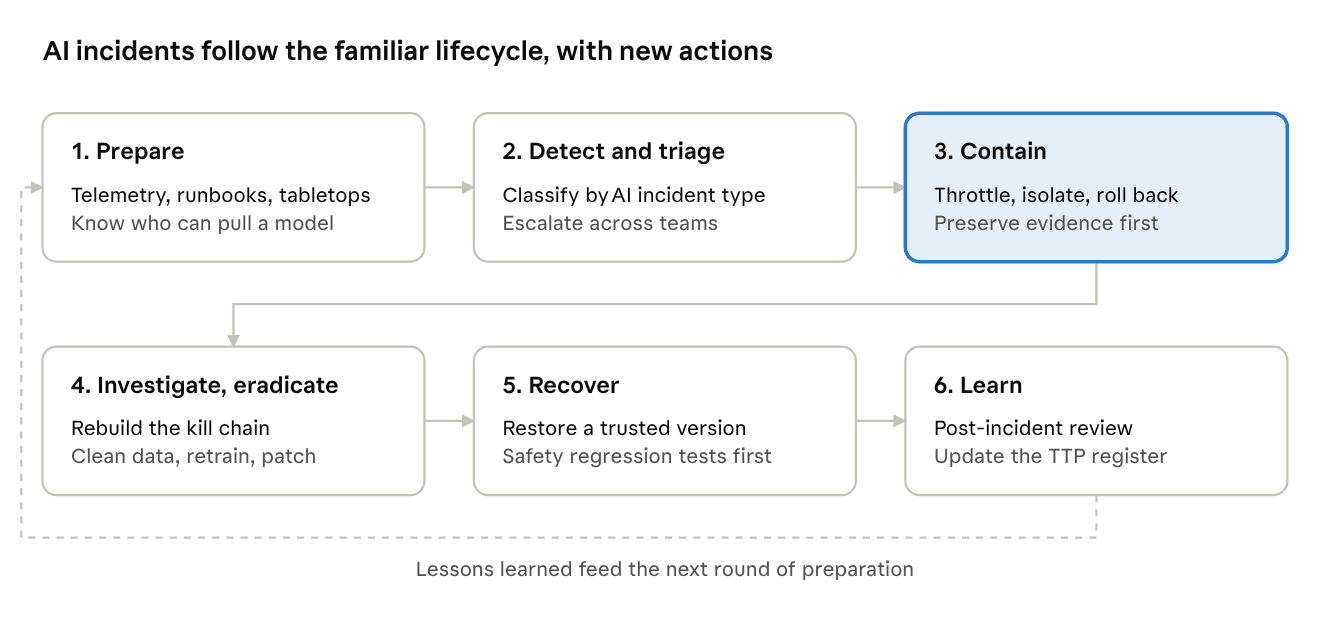
AI-specific triage taxonomy
Triage sorts incoming incidents by type and severity so the right people respond in the right order. A shared taxonomy, a fixed set of incident categories, means everyone describes incidents the same way. The outline names four types:
| Type | What happened | Early signs | Typical first containment |
|---|---|---|---|
| Prompt injection | Instructions from an attacker, typed directly or hidden in content, changed the system's behavior | Odd tool calls, outputs with unexpected links, policy violations | Block the source, disable the affected tool, quarantine the document |
| Jailbreaking | A user got around safety restrictions to produce prohibited output | Filter hits, refuse-and-retry patterns, harmful output reported | Block the user or session, tighten filters, rate limit |
| Data poisoning | Training or knowledge data was altered to change behavior | Accuracy drops on certain inputs, trigger-like behavior, unexplained dataset changes | Take the model out of service or roll it back, freeze the data |
| Model theft | Weights were stolen, or the model was copied through its API | Large outbound transfers, extraction query patterns | Revoke access, rotate credentials, rate limit, isolate storage |
Most organizations add a few more: sensitive data disclosure, agent misuse, supply chain compromise and denial of service or denial of wallet. Severity depends on harm to people, the data involved and how far the problem reaches.
Multi-disciplinary escalation paths
AI incidents cross team lines faster than most. Decide in advance who gets pulled in and when:
- SecOps leads the technical response.
- MLOps handles rollbacks and pipeline controls.
- Data science analyzes model behavior, works out whether data was poisoned and leads retraining.
- Legal assesses notification duties, preserves privilege and decides on law enforcement contact.
- Privacy and compliance handle regulators. GDPR requires notifying the supervisory authority of a personal data breach within 72 hours of becoming aware of it, and the EU AI Act requires providers of high-risk systems to report serious incidents.
- The model or business owner decides whether to take the system offline and accepts the business impact.
- Communications handles customers, staff and the press.
Notification clocks start early, so legal belongs in the escalation path from the start.
AI-specific containment actions
Containment stops the harm from spreading while you work out what happened. AI-specific options include:
- model rollback to the last trusted version;
- endpoint isolation, taking an inference endpoint off the network or restricting it to known callers;
- rate limiting the attacker, or everyone if needed;
- disabling specific tools or integrations and revoking their tokens;
- quarantining suspect documents and pointing RAG at a trusted snapshot of the knowledge base;
- tightening guardrails and blocking specific users or keys; and
- falling back to a manual, non-AI process.
Containment trades availability for safety. When people could be harmed, take the system down.
Pipeline suspension and agent termination
Pipeline suspension halts training, fine-tuning and deployment pipelines when poisoning or tampering is suspected, so contaminated artifacts don't spread to other models. Freeze automatic retraining and block promotions until the investigation clears them.
Agent termination stops running agents with the kill switch, revokes their credentials, cancels their scheduled tasks and stops any sub-agents they started. Then check for persistence: an agent under an attacker's influence may have created scheduled jobs, new accounts or API keys. Agents with long-term memory deserve special attention, because an injected instruction stored in memory can come back in every future session. Quarantine that memory.
Preservation of investigative artifacts
Containment can destroy evidence. Rolling back a model overwrites the version you need to examine, and retraining replaces the poisoned data's fingerprints. So preserve first, with hashes and chain of custody:
- model weights and state;
- configurations, including the system prompt, guardrail settings and tool permissions;
- dataset, knowledge base and vector store snapshots;
- agent memory and session data;
- logs of prompts, retrievals and tool calls; and
- container images.
Capture the most volatile items, like running sessions and memory, first, and place everything under legal hold when litigation or regulatory action is possible.
5.6 Investigation, eradication and forensics
Attack kill chain reconstruction
A kill chain is the sequence of steps an attacker takes from first contact to final impact. Reconstructing it shows how the attack worked, which controls failed and where to add new ones. MITRE ATLAS organizes AI attack techniques by tactic in the same style as ATT&CK, which gives you a common vocabulary for each step. The outline names two kinds of chains to practice on.
A data poisoning chain might run like this: the attacker gains write access to a data source, poisoned samples get collected, they pass validation, the model trains on them, the model is deployed, and later the attacker uses the trigger. For each step, find the evidence and the control that should have stopped it.
An untrusted tool output chain might run like this: an agent calls a web search tool, a result page contains hidden instructions, the model follows them, it calls the email tool with internal data, and the data leaves. The evidence lives in tool call logs, the retrieved content and the model's outputs, which is why 5.2 insisted on logging all three.
Root cause analysis, forensics and timelines
Root cause analysis (RCA) looks past the immediate cause to the underlying ones. In the email example, the immediate cause is that the agent sent data out. The root causes are that the agent held a send permission it didn't need, outputs weren't limited to approved domains, and web content wasn't treated as untrusted. Real incidents usually have several contributing causes. Methods like the five whys and fishbone diagrams help find them.
AI forensics applies investigation techniques to AI artifacts:
- compare model versions by hash, by their weights and by their behavior on a fixed test set;
- probe a suspect model for backdoor triggers;
- search dataset snapshots for injected samples, such as outliers, near-duplicates with changed labels, or records added around the time of the attack;
- search the vector store for injected documents by insertion time and source; and
- replay logged prompts against the preserved model version in an isolated environment to reproduce the behavior. Models don't always give the same answer twice, so fix the settings that control randomness where you can, and record exactly which version you tested.
A timeline puts every event in order using synchronized timestamps: the first malicious action, detection, containment and every response step. Poisoning attacks can have a long dwell time, the gap between compromise and detection, because the poison enters the data long before anyone notices the model behaving oddly.
Threat actor attribution
Attribution identifies who was behind an attack, using their techniques, infrastructure, artifacts and matches against threat intelligence. It's hard, often lands at low confidence, and many AI incidents come from opportunistic individuals rather than organized groups. Attribution helps you understand intent, anticipate what comes next, support law enforcement and share intelligence. It isn't needed to contain or eradicate, so never delay the response while you work out who did it. State a confidence level with any attribution, and leave formal attribution to law enforcement and intelligence agencies.
Threat eradication
Eradication removes the cause of the incident and everything it touched:
- Data sanitization removes poisoned samples, malicious knowledge base documents and contaminated agent memory. Follow lineage to every copy and every dataset derived from the bad data, then scan again to confirm it's gone.
- Model retraining rebuilds the model from a clean dataset version, or restores a checkpoint from before the incident and fine-tunes it on clean data. Unlearning methods are a fallback when retraining isn't possible, with lower assurance.
- Patching vulnerabilities fixes the weakness that let the attack work: removing an excess permission, adding a domain allow-list, updating a library, rotating credentials or closing write access to a data source.
Where you can, rebuild from trusted sources instead of trying to clean a compromised artifact in place.
Safety regression testing before reintroduction
Regression testing re-runs existing tests to confirm a change didn't break something that used to work. Safety regression testing does that for safety and security before a repaired system returns to production: the full jailbreak and injection suite, including the exact attack from the incident, plus bias and accuracy evaluations, backdoor trigger tests and guardrail tests. Compare the results with the pre-incident baseline, get the model owner's sign-off, and bring the system back in stages with closer monitoring than usual. Then add the incident's attack to the permanent test suite, so the same thing gets checked on every future release.
5.7 Recovery, business continuity and post-incident review
Recovery strategies
- Trusted model rollback returns to the most recent version in the registry that is signed, verified and older than the compromise. Check that last part carefully. Because poisoning can have a long dwell time, the version right before the current one may be poisoned too.
- Clean checkpoint restoration uses checkpoints, saved snapshots of a model taken during training. Restore one from before the bad data entered, then continue training on clean data. That only works if checkpoints were stored write-once with hashes.
- Vector store recovery restores the index from a clean snapshot, or rebuilds it by re-embedding verified source documents. Check the source documents themselves, since rebuilding from poisoned sources rebuilds the poison. Many teams never back up their vector stores, so add them to the backup plan before you need them.
Restore system prompts, guardrail settings and other configuration from version control too, and rotate every credential the incident may have exposed.
AI circuit breakers and kill switches
A circuit breaker is an automatic control that trips when a threshold is crossed, like an error rate, a cost spike, a burst of policy violations or unusual tool calls, and stops or limits the AI function until a person resets it. If an agent issues more refunds in an hour than it ever has before, the breaker pauses it.
A kill switch is a manual control that lets an authorized person shut an AI system or agent down immediately. It has to work even when the AI system is misbehaving, so it's built outside the AI's control, by revoking credentials or disabling access at the gateway. Test it regularly.
The difference to remember: a circuit breaker is automatic and triggered by thresholds, and a kill switch is a deliberate human decision.
Business continuity, disaster recovery and dependency mapping
Business continuity (BC) keeps critical business functions running during a disruption. Disaster recovery (DR) restores the IT systems behind them. A business impact analysis (BIA) identifies which functions are critical and sets two targets for each: the recovery time objective (RTO), the longest acceptable outage, and the recovery point objective (RPO), the most data loss you can accept, measured in time.
Critical AI dependency mapping traces what each AI system depends on and which business processes depend on it. AI dependencies include the model provider, GPU capacity, the vector database, the embedding model, data pipelines, guardrail services, the identity provider, MCP servers and other tools, and the system prompt and configuration. The map shows single points of failure, like a business process that stops whenever one model provider has an outage.
Two AI-specific traps sit in continuity plans:
- A backup model isn't a drop-in replacement. Prompts and guardrails tuned for one model can behave differently on another, so test the failover model with your real prompts before you need it.
- Changing the embedding model makes the existing vectors unusable, so a forced switch means re-embedding the whole knowledge base. Plan for that time in the RTO.
Other continuity options include cached responses for common requests, manual procedures that trained staff can actually run, and backups of models, indexes and configuration.
Post-incident reviews and the TTP register
A post-incident review, or lessons-learned session, happens soon after the incident and is blameless, focused on how the system failed rather than who to punish, so people speak openly. It covers what happened, what worked, what didn't and the root causes, and it ends with action items that have owners and due dates. Typical outputs are updated playbooks and runbooks, new detection rules, new test cases, control changes and training.
TTP stands for tactics, techniques and procedures, the way attackers operate. A TTP register catalogs the TTPs seen in your own incidents and in threat intelligence, mapped to MITRE ATLAS or ATT&CK, with the detections and controls for each and any gaps. Update it after every incident, and share what you can through your sector's information sharing and analysis center (ISAC).
Secure decommissioning, disposal and remediation
When a model is retired, whether at end of life or after a compromise:
- Model termination removes it from service, revokes its endpoints and keys, marks it retired in the registry, deprovisions its agent identities (Domain 4) and removes its tool integrations.
- Machine unlearning (Domain 4) applies when a model stays in service but specific data has to come out of it.
- Disposal securely deletes weights, datasets, vector stores, caches, expired logs and backups, including copies in other environments, using the sanitization methods from Domain 3, with certificates of destruction.
- Remediation deals with what the model already did. Decisions made, records changed and content published by a compromised model may need review and correction, and affected people may need to be told.
Keep the records audits require, like the model card and decision logs, even after the weights are gone.
Practice questions
These are my own questions in the ISC2 style. Pick the BEST answer, and when two look right, put the safety of people first, then legal obligations, then the mission.
- The team suspects that poisoned data affected a production model that drafts internal marketing copy. They want to roll it back right away. What should happen FIRST?
- A. Preserve the current model, its configuration and dataset snapshots, with hashes
- B. Roll back to the previous version
- C. Start retraining on a new dataset
- D. Brief the communications team
- A hospital's AI dosing assistant starts recommending doses outside normal ranges. What should happen FIRST?
- A. Preserve the model and logs for investigation
- B. Stop using the assistant in patient care and switch to the manual process
- C. Begin root cause analysis
- D. Determine who attacked the system
- An agent with access to customer records sends data to an outside domain right after reading a web page during a research task. Which incident category BEST fits?
- A. Jailbreaking
- B. Model theft
- C. Prompt injection
- D. Data poisoning
- Which mechanism automatically pauses an agent when the number of refunds it issues in an hour crosses a set threshold?
- A. Kill switch
- B. Canary token
- C. Honeytoken
- D. Circuit breaker
- After poisoning is discovered, the team rolls the model back to the previous version, but the malicious behavior continues. What is the MOST likely explanation?
- A. The previous version was also trained on the poisoned data, because the poison entered long before it was detected
- B. The rollback wasn't signed
- C. The model provider pushed an update
- D. The kill switch failed
- In a human-in-the-loop loan review, the reviewers' override rate falls from about 8% to nearly zero over two months, with no change to the model. What should the security professional suspect FIRST?
- A. The model has improved
- B. Reviewers have started approving outputs without real review
- C. An attacker is manipulating the model
- D. The logging system has failed
- During a prompt injection incident, an executive asks the team to identify the attacker before taking any containment action. What is the BEST response?
- A. Delay containment until the attacker is identified
- B. Close the incident without attempting attribution
- C. Contain and eradicate now, and pursue attribution separately with a stated confidence level
- D. Publicly name the group the team suspects
- A model was retrained after a poisoning incident. What must happen before it returns to production?
- A. Sign-off from the model owner alone
- B. A successful load test
- C. A code review of the training pipeline
- D. A safety regression test suite that includes the attack from the incident
- Which telemetry design BEST balances investigation needs and privacy for an AI application?
- A. Mask personal data before logs reach the SIEM, and keep unmasked prompts in a restricted store with short retention and logged access
- B. Send all prompts unmasked to the SIEM so investigations are complete
- C. Disable prompt logging entirely
- D. Log only request counts and discard all content
- The same jailbreak weakness is found in several AI systems. Which should be addressed FIRST?
- A. An internal tool that summarizes public documents
- B. An internet-facing agent that can issue payments
- C. An offline batch model that processes test data
- D. A model in a development sandbox
- An organization's continuity plan names a backup model provider, but no one has tested it with production prompts. What is the BEST action?
- A. Assume the backup model will behave the same way
- B. Remove the backup provider from the plan, since it's untested
- C. Test the backup model with real prompts and guardrails, and update the plan with what you learn
- D. Increase the quota with the primary provider
- A compromised model has been taken out of service. Which remediation step is MOST often overlooked?
- A. Deleting the model weights
- B. Revoking the model's API keys
- C. Marking the model retired in the registry
- D. Reviewing the decisions and content the compromised model produced
Show the answer key
- A. Nobody is in danger from marketing drafts, so preserve the evidence before changing anything. A rollback (B) overwrites the version you need to examine.
- B. Patients could be harmed, so stopping the harm comes before everything else, including evidence preservation. Investigation follows once patients are safe.
- C. Instructions hidden in the web page redirected the agent. That's indirect prompt injection, and the data leaving is its impact.
- D. A circuit breaker trips automatically on a threshold. A kill switch (A) is a manual decision.
- A. Poisoning can sit undetected for a long time, so a rollback target must be verified as older than the compromise.
- B. With no model change, a collapsing override rate points to automation bias: reviewers have stopped checking. That's a failure of oversight, and oversight is a control.
- C. Containment never waits for attribution. Attribution is useful, often uncertain, and a separate track.
- D. Safety regression testing, including the incident's attack, has to pass before reintroduction. Owner sign-off still matters, but it comes after the tests.
- A. Masking protects privacy in the broadly accessible SIEM, and the restricted store keeps what investigators need. B over-collects, while C and D leave nothing to investigate.
- B. Context sets priority. Internet exposure combined with the power to move money makes it the most urgent.
- C. Prompts and guardrails tuned for one model can behave differently on another. An untested failover gives false confidence, and the fix is to test it instead of dropping it.
- D. Recovery isn't finished while harmful decisions made by the compromised model are still standing.
Sources
- ISC2 AI security certification outline
- NIST SP 800-61 Rev. 3, Incident Response Recommendations and Considerations for Cybersecurity Risk Management
- MITRE ATLAS
- NCSC and CISA, Guidelines for Secure AI System Development
- CISA, NSA, FBI and partners: AI Data Security (May 2025)
- OWASP GenAI Security Project
- OpenTelemetry semantic conventions for generative AI
- CISA Known Exploited Vulnerabilities catalog
- FIRST, Exploit Prediction Scoring System (EPSS)
- CISA, Stakeholder-Specific Vulnerability Categorization (SSVC)
- GDPR full text, including Article 33 on breach notification
- AI Incident Database